
This writing will provide you useful information about thundereggs with its benefits, and place that you can find in the US
Thundereggs are technically not a rock, but it appears like a rock to the untrained eyes. The only indicator to differentiate with average rock is a spherical shape. When you can freely cut it in half and have it polished, you can find attractive patterns where internal contents are revealed.
More specifically, thunderegg is a geological structure, sometimes a geode, and sometimes a nodule formed inside other rocks. It usually has the size of a golf ball or baseball. They can be found in different sizes ranging from less than an inch to 5 feet in diameter and more than a ton of weight.
Besides, thundereggs have many benefits, including the ability to help improve mental function, strengthen self-esteem, and self-confidence. Given that reason, many people would like to have it as jewelry or a gift for your beloved ones.
Thundereggs can be found globally in optimal conditions. In the US, thundereggs can be found mostly in Oregon, and it was designated as the official state rock of Oregon in 1965.
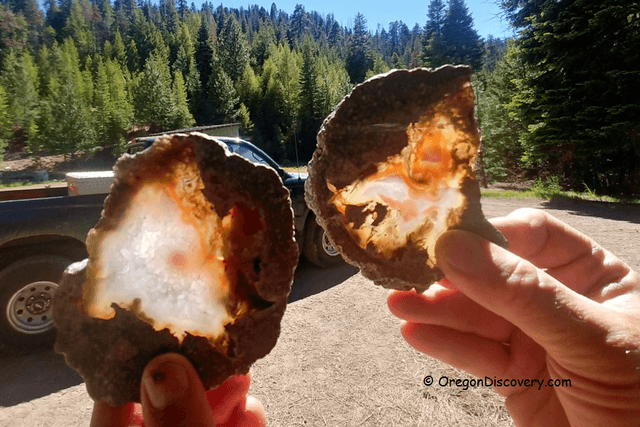
Thunderegg is designated as official state rock of Oregon
The world’s largest thunderegg of 1.75-ton specimens lies in the Rice Northwest Museum of Rocks and Minerals in Oregon. And the most beautiful and colorful thunderegg can be found in Jefferson County in Central Oregon (Pony Butte).
This writing will give you more information about thunderegg, its benefits, values, how they were formed, how to spot, and the top 8 places for digging thundereggs in the mostly thunderegg founded areas in the State of Oregon in the US.
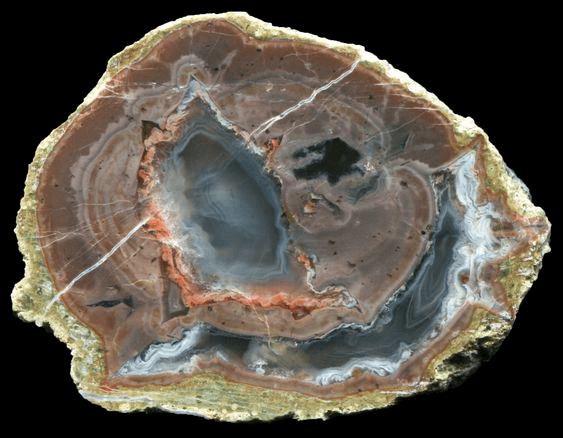
How Were Thundereggs Formed?
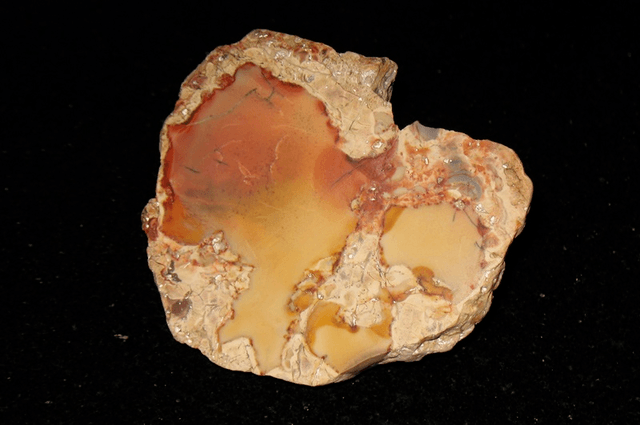
Another thunderegg sample
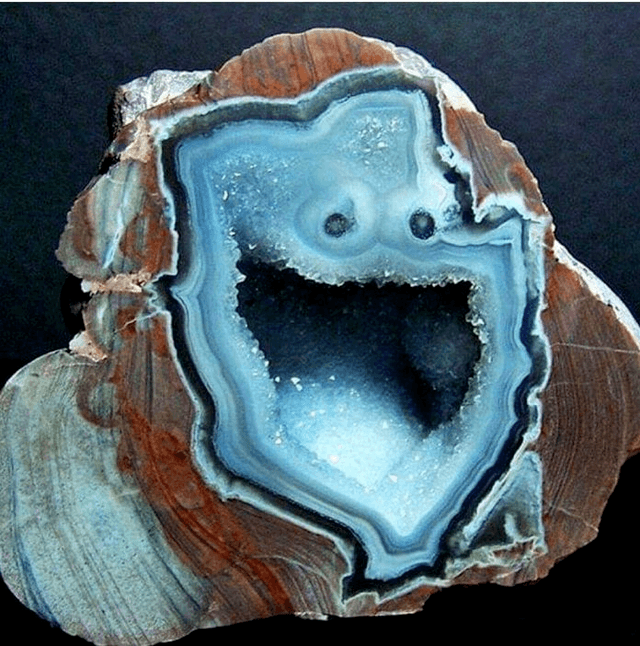
Thundereggs were formed millions of years ago in the flow of rhyolite lava. First, there is a hollow in rock formed when gas bubbles formed the flow of rhyolite lava.
Later, the porous rock carrying rich silica fluids from the action of water was crystallized and solidified. Over the years, it is also laced with other minerals such as agate and jasper.
The complex process of forming thundereggs is regulated by the constant change of chemical and physical conditions such as fluid composition, depth of formation, pressure, temperature, groundwater composition, magma composition, and host rocks composition.
Those chemical and physical condition variations result in no thunderegg looking precisely like others. Different colors of thundereggs were collected from the difference of minerals impurities contained in the bands from the soils and rocks that the water flows through.
Thundereggs are filled with jasper, opal, agate, and other minerals. Most thundereggs range from 1/4 inch to 5 feet in diameter and more than a ton in weight.
Thundereggs Benefits
Thundereggs help strengthens mental functions, build self-confidence and self-esteem. It also helps improve analytical abilities and concentration. In the old mythology, thundereggs are believed to be thrown down by angry gods due to his dissatisfaction with human events.
Thundereggs are made into beautiful jewelry, decorative pieces, bookends, bolo ties and pendants, and a pen stand that can be a precious gift for yourself and your beloved ones.

Thundereggs Value: How Much They Worth?
According to the all-oregon.com site, thundereggs are valued between $1 and over $ 100 per slice or cabochon.
If you are curious about the value of thundereggs, you can check out our article on opal rock. Opals and thundereggs share some similarities, and knowing the value of opals can give you a better understanding of how to price and sell thundereggs. Opal pricing depends on its type, history, rarity, and other factors that we have discussed in our article.
The Most Valuable Thundereggs
Thundereggs with plumes as flowers in chalcedony are among the most valuable materials. Other specimens such as zeolite, clinoptilolite, natrolite, mesolite, and modernite are reported.
How To Spot Thundereggs ?
Though it appears like a rock to the untrained eyes, it can be identifiable by spherical and bumpy brown-gray surfaces. Thundereggs lay relatively close to the Earth’s surface and were formed in the clay of tuff, which has been later decayed to clay and soft-mud, making thundereggs noticeable compared to average rocks.
Thunderegg vs Geodes: Differences
While geode is simply any hollowed rock, which has been often filled with mineral deposits, a thunderegg is a kind of geologic structure formed only in rhyolite lava flows and indicated by certain mineral deposits.
Thundereggs, in general, contain a more solid structure, while geodes often contain a matrix of crystals.
In the next section, we would like to let you know about where to find thundereggs in Oregon and suggest you of the top 8 places for hunting thundereggs in public areas known as free sites and pay-for-dig sites to collect thundereggs for those who are interested in this beautiful structure.
Where to find thundereggs in Oregon?
You can find thundereggs in most Oregon locations, especially in Central and South-Eastern Oregon. Some localities are in the desertlike terrain or charming forested hill country.
Thundereggs have been collected in Oregon for almost fifteen years and can be discovered in fee sites or free sites. While some free sites allow rockhounds to dig and work for collecting thundereggs with proper equipment, pay-to-dig sites require rock seekers to pay a small fee because overburdened preparatory works were done.
These pay-to-dig areas are placed on privately owned lands that you may have to purchase thundereggs at the site office. It is said that you can find the highest quality thundereggs there.
Collectors of thundereggs should contact the site for fee status as well as relevant authorities for digging permission.
Besides, as collectors or people searching for thundereggs, you surely need to bring a sturdy shovel, hand tools like rock hammers, picks, safe vehicles, food, water, maps, and supplies.
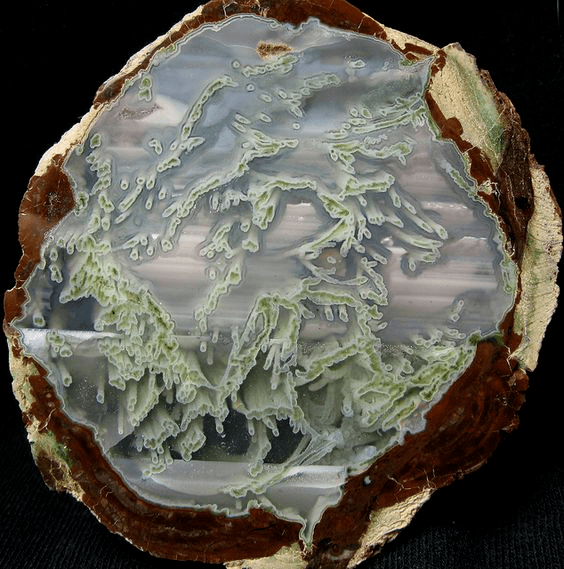
Most people enjoy the natural beauty of the thunderegg plus the benefits that it brings. Simultaneously, different locations have different types of thundereggs with different colors and distinct internal compositions.
Thus, many people found it fun, challenging, and adventurous for family and kids to finding the eggs, and the reward of finding a beautiful gift from Mother Nature is well deserved.
Explore the beautiful Mt. Hood National Forest, where you can find plenty of thundereggs. Check out the top attractions and things to do in the area, including hiking and exploring natural wonders. You may discover a lucky thunderegg during your adventure!
Top 8 Thunderegg Sites in Oregon
Succor Creek Canyon
Succor Creek Canyon is a public site managed by Oregon State Park and BLM. The site has been known as the top rockhounding place in Oregon for long. The site is located between Jordan Valley and Adrian; Succor Creek has beautiful scenery and abundance of thundereggs.
Although Succor Creek has been hunted for years, people still come and seek for more thundereggs. The area for collecting is significant so that many good thundereggs may hide in some areas along the creek on gravel deposits and on the hillside after crossing the bridge.
You can enjoy great driving while watching spectacular scenery on the way to get to Succor Creek Canyon. Here you can find not only thundereggs but also jasper, agate, petrified wood and fossils along Succor Creek Canyon or at the site near Rockville School. You are thus keeping close eyes on it.
Leslie Gulch – Owyhee Reservoir
Leslie Gulch – Owyhee Reservoir is a public site that is managed by BLM. The site lies at the upper end of the Owyhee Reservoir. Especially when the reservoir level is low in the summer, it is a paradise of rockhounds.
You can enjoy the beautiful ride through Lesli Gulch to get to Owyhee Reservoir in Oregon. On the same path to Succor Creek Road, you will turn right and continue right, drive 1.5 miles to Leslie Gulch Road, then turn left, and the next 14.2 miles will be the destination.
You can find so much ground to explore and many suitable materials, including thundereggs, jaspers, agates, petrified, and fossil materials.
It is recommended to drive in a high-clearance vehicle and bring a geology pick and necessary hand tools with you to hunt for thundereggs. The road may be impassable in wet weather conditions.
White Fir Springs
White Fir Springs is a friendly rockhounding site in Oregon’s center inside the Ochoco Mountains in Oregon. This site is public land administered by the US. Forest Services.
To get to the rock hunting site, you need to drive one and half an hour from Bend, Oregon. When you are at the Route 26 junction with Wildcat Road, turn left onto NF3350, you can see the Forest Service marks the location with a sign of about 4 miles from Route 26 junction.
Due to the geologically complicated plateau with the above later fossil-bearing layers, the current terrain is created under basalts and layers of volcanic ash, lava, and mud covering more than 1,000 feet deep. Thus, you can find very different thunderegg from other regions.
Looking for a nearby biking trail? Check out our article on the best bike brands for an enjoyable ride. With a wide range of options to choose from, you can find a bike that fits your preferences and skill level. Hit the trails for a fun adventure!
White Rock Springs
Another public access site for rockhounding is White Rock Springs, which is adjacent to White Fir Springs in Ochoco National Forest in Prineville in Oregon. Likewise, the site is public land managed by US Forest Services.
You can find jasper thundereggs in many color combinations such as yellow, brown, reds, tans, and mauves. Though it’s hard to find materials, the thundereggs there are distinct and beautiful because of unusual shades and patterns.
To get into the rockhounding site area, you can follow US26 to milepost 41, then turn left on the road 3350, and the site is right on the road 3350-300.
Be cautious that collecting is not allowed within the Mill Creek Wilderness boundary.
Whistler Springs
Whistler Springs is on public land and administered by the US. Forest Services. The site is located in Central Oregon and has been known as a rockhounding site for many years. Still, quality thundereggs can be explored by determining rockhounds. Make sure you bring some hand tools to dig through the hard rhyolite matrix to break rocks.
Besides, you can enjoy a great camping experience with many activities when exploring rockhounding sites in the Ochoco National Forest.
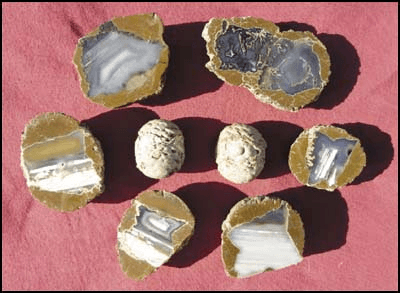
Similar thunderegg like this can be found at Whistler Springs
https://www.fs.usda.gov/detail/ochoco/recreation/?cid=stelprd3825804
Thunderegg Lake
As its name, Thunderegg Lake is north of California and south of Lakeview in Lake County in Oregon.
You can find digging pits very close to the north of Thunderegg Lake. On the other hand, you can also search for Crane Creek’s gravels and find some good materials here. It is a very remote and elevated site making a perfect spot for a hike and thunderegg hunting in the summer.
If you’re interested in geology, you’ll love exploring Thunderegg Lake. The volcanic forces that created the thundereggs are fascinating, and you can learn more about the geology of the Pacific Northwest at Pacific Northwest Geology, which showcases the formation of volcanoes that took place millions of years ago.
Alvord Desert
Heading to Southern Oregon, you can find an excellent public thunderegg site at Pike Creek in Alvord Desert on the Eastern side of the Steens Mountains.
You have to travel 65 miles southeast on OR-78 from Burns to Folly Farm Road to get there. Next, turn right to the Folly Farm Road, follow 2.5 miles, and 22 miles more to partially gravel Mann Lake road. You can find Pike Creek located about 15 miles from the southern side of Mann Lake.
This site is one of the few-year round creeks close to Alvord Hot Springs. Though it is not a favorite rockhounding place, you can explore good material around the vast desert. You can also explore jasper, geodes, petrified wood, and agate material in addition to thunderegg.
Lucky Strike Mines
Lucky Strike Mines is a pay-for-digging site located close to Mitchell The site is only open during the summer season. You can find some of the most beautiful thundereggs here for a very reasonable price. The reason people come back during rockhounding season is because of the different beautiful colors within these thundereggs.
However, finding thunderegg can be challenging, and it requires a capable high-clearance vehicle. Ensure you also know directions before leaving home because it’s challenging to navigate Oregon’s most remote central and eastern parts.
Final words
In a nutshell, hunting an official state rock in Oregon is not only a fun experience but also a good reward for yourself or your beloved ones if you finally get one. It doesn’t matter whether you choose a free site or a pay-to-dig site, make sure you research about the site so you can have a quality hunting time. Other than that, it’s also an excellent reason to escape the crowd and go camping on the same occasion.
Since the information provided in this writing is subject to change anytime, please keep updating and search for updated information if you decide to go for rockhounding.
In conclusion, if you’re looking for a unique outdoor activity in Oregon, consider searching for sunstones! Not only can you potentially find a beautiful gemstone, but you’ll also get to explore some of the state’s beautiful wilderness areas. For more information on Oregon’s outdoors, check out Mark O Hatfield Wilderness Overview.
FREQUENTLY ASKED QUESTIONS
Q: How large is the size of thunderegg? How is it weight?
Most thundereggs range from 1/4 inch to 5 feet in diameter and more than a ton of weight.
Q: What is the world’s largest thunderegg?
The world’s largest thunderegg of 1.75-ton specimens lies in the Rice Northwest Museum of Rocks and Minerals in Oregon.
Q: Where can I find the best thunderegg?
While some free sites allow rockhounds to dig and work for collecting thundereggs with proper equipment, pay-to-dig sites require rock seekers to pay a small fee because overburdened preparatory works were done.
These pay-to-dig areas are placed on privately owned lands that you may have to purchase thundereggs at the site office. And the fact that thundereggs maybe less found in free sites because more people have come to search for it, you may find better quality thundereggs in pay-to-dig locations.
The most beautiful and colorful thunderegg was found in Pony Butte, Jefferson County, in Central Oregon.
Q: How much is usually thunderegg worth?
Thundereggs are valued between $1 and over $ 100 per slice or cabochon.
Q: How to spot thunderegg?
Thundereggs were formed in the clay of tuff, which has been later decayed to clay and soft-mud, making thundereggs noticeable compared to average rocks.
Q: What do you need to bring for thunderegg hunting?
For collectors or people like searching for thundereggs, you surely need to bring a sturdy shovel, hand tools like rock hammers, picks, safe vehicles, food, water, maps, and supplies.
Q: If I am not living in Oregon, where to find thunderegg in other areas?
Apart from Oregon, you can find thundereggs in Germany as an essential center for agate thunderegg (such as Gehlberg and St Egidien ). Other places known for searching thundereggs include Mexico, Canada, Ethiopia, Romania, Poland, Turkey, Mexico, Argentina, Mount Hay, the Esterel massif in France, and Tamborine Mountain in Australia.
